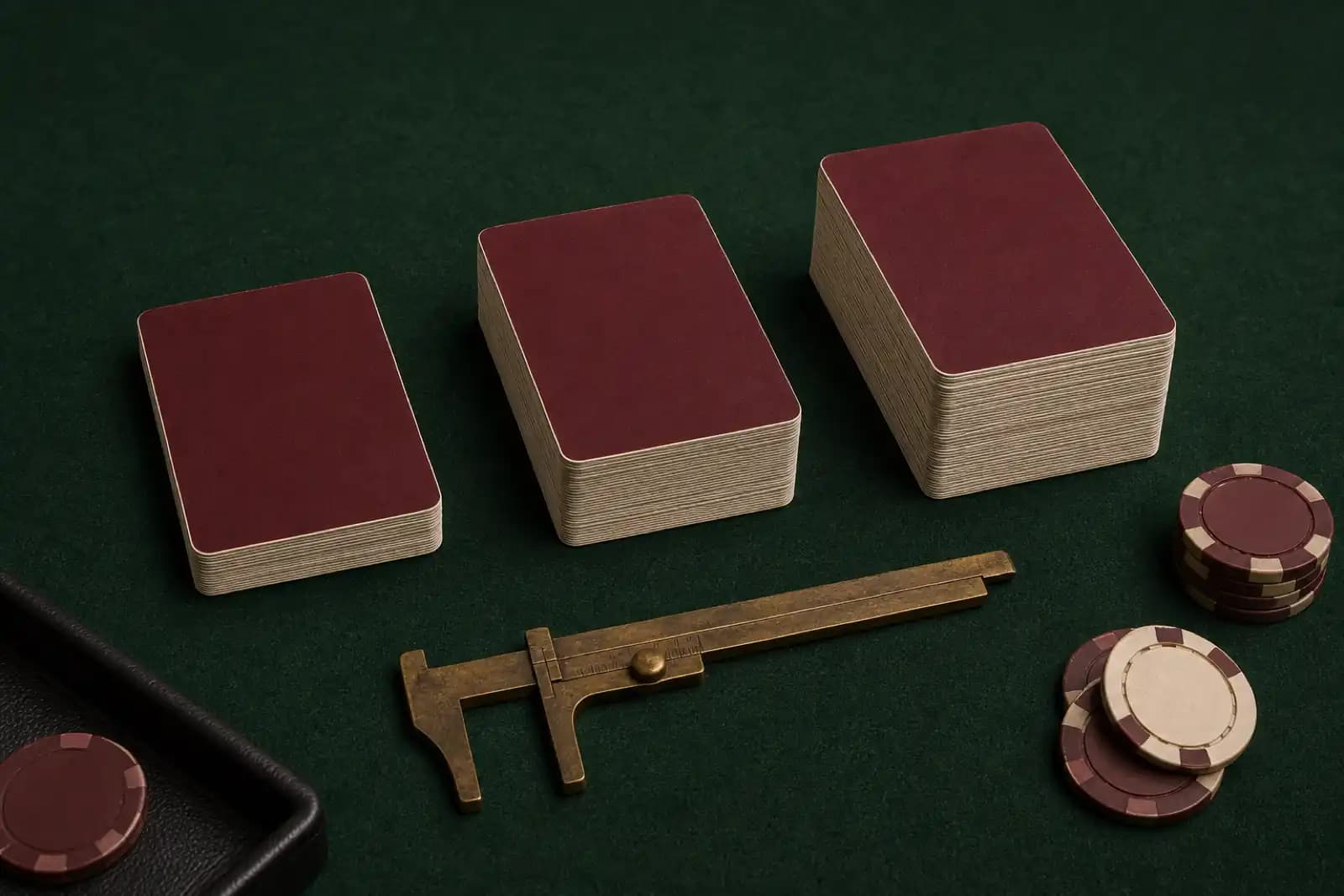
Deck count changes removal effects
Cards are dealt without replacement. In one deck, removing a five or ten changes the composition of 51 remaining cards immediately. In an eight-deck shoe, the same card is one observation among 415 remaining cards. The direction is the same; the size is smaller in the larger shoe.
After a ten-valued player card, the chance of an ace as the second card is 4/51, or 7.843%, in one deck. In eight decks it is 32/415, or 7.711%. Open Probability Lab at /en/probability and remove the same exposed card from one and eight decks to inspect the difference.
| Stage | Scope |
|---|---|
| Table rules | Full profile |
| Public cards | Visible state |
| Hand category | Hard, soft or pair |
| Legal actions | Current decision |
House edge belongs to a full ruleset
Deck count alone does not define house edge. Dealer soft-17 treatment, blackjack payout, doubling permissions, double after split, re-splitting, surrender, blackjack checks, and player strategy also determine the result. Table conditions can move value by more than the difference between neighboring deck counts.
| Decks | House edge | Conditions held constant |
|---|---|---|
| 1 | 0.014% | 3:2 blackjack, H17, DAS, no surrender, total-dependent basic strategy |
| 8 | 0.577% | 3:2 blackjack, H17, DAS, no surrender, total-dependent basic strategy |
These values are a controlled comparison, not a rating for every table with the same deck count. Enter the full conditions in /en/house-edge, then use /en/rules/compare to change one rule at a time.
Why basic strategy can change
Most basic-strategy entries stay stable across familiar deck counts. Close decisions deserve separate tables because card removal shifts the expected return of hit, stand, double, and split by different amounts. A single-deck composition-sensitive calculation can distinguish hands that share a numerical total, such as 6,4 and 5,5.
Use a chart calculated for the exact deck count and rules. Strategy Tables at /en/strategy/tables presents a policy; a live probability panel describes cards observed in a particular round.
Fewer decks help under like-for-like conditions
With identical baseline conditions, fewer decks generally improve the player expected return. Natural-blackjack frequency and the effect of player choices on stiff totals respond to card removal. Doubling and splitting respond differently because their starting hands and follow-up cards use different compositions.
A single-deck table can offset its structural benefit with a 6:5 blackjack payout, restrictive doubling, limited resplitting, or other unfavorable rules. Compare the complete rules before treating the deck label as a verdict.
Deck count and counting are related, yet separate
In a multi-deck shoe, running count needs normalization by decks remaining. The true count puts the running count on a per-deck scale. Penetration matters because more exposed cards can create a more informative composition signal. The True Count tool at /en/counting/true-count demonstrates the conversion without making a claim about future profit.
A comparison you can repeat
- Set up one-deck and eight-deck games with the same payout and dealer rule.
- Compare fresh-shoe house edge, then remove the same visible cards and inspect next-card rows.
- Change one major rule while holding deck count constant and record every setting with the result.